Google Gives Gemini a Face: What Live Avatars Mean for Enterprise Voice AI in MENA
Google has made Gemini 3.8 Live with Live Avatar available to enterprises, combining real-time video avatars, live vision and background task execution. Here's what it does and what it means for voice AI deployments in MENA.
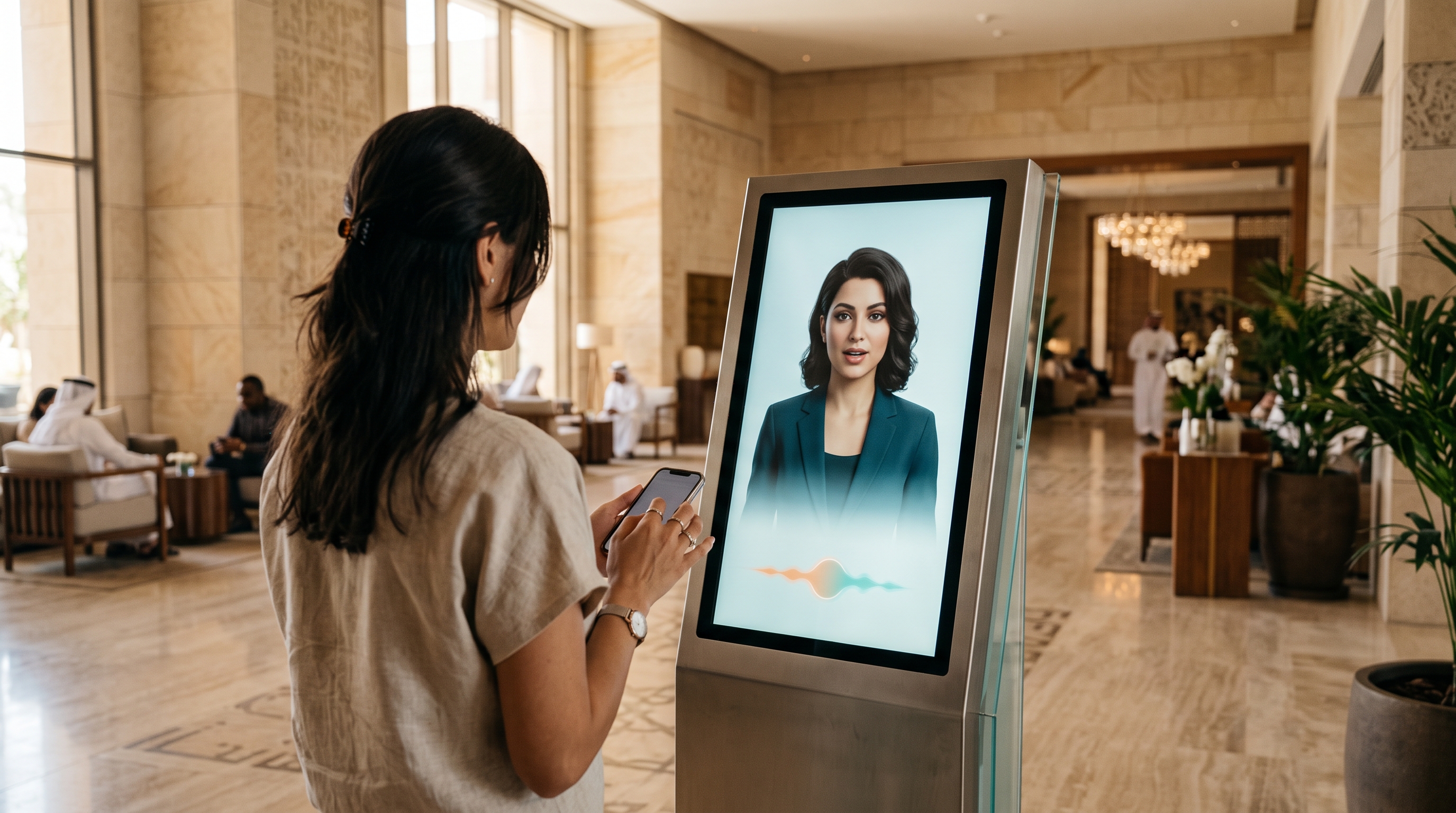
Google has made Gemini 3.8 Live with Live Avatar generally available through Gemini Enterprise. The feature was first previewed at Google Cloud Next 2026. It adds a video avatar, generated in real time, on top of Google's speech-to-speech model, so enterprise AI agents can now be seen as well as heard.
For teams running conversational AI in customer service, the avatar itself matters less than the stack underneath it. That stack puts live vision, background task execution and multilingual speech into a single session.
What Google launched
- Avatars that speak with synchronized facial expressions and lip movements, generated live during the conversation
- Camera feeds and screen sharing processed alongside audio
- Tool and API calls that run in the background without pausing the dialogue
- Speech-to-speech in 97 languages, with automatic language detection
- A curated library of pre-built avatars, with custom avatars available through allowlisting and verification
- SynthID watermarks embedded in generated audio and video
- Access through Gemini Enterprise and Google's API, on US and European endpoints, with provisioned throughput and enterprise compliance and data-governance controls
Generated, not animated
This is not a prerecorded character placed in front of a chatbot. The video is produced as part of the live interaction, so the avatar responds as the conversation changes. Its expressions and lip movements track the model's synthesized speech. Google's developer documentation specifies 24-frame-per-second video output alongside 24 kHz audio.
The model handles audio, video and text in both directions. Developers can therefore build experiences where a user speaks to the agent and shows it something at the same time. Google is positioning the avatar for customer service, interactive walkthroughs and similar use cases. The target surfaces are web apps, mobile experiences and interactive kiosks.
The agent sees what the customer sees
Gemini 3.8 Live can take in a live camera feed or a shared screen during a voice conversation. Customers no longer have to describe everything out loud. The agent can work directly from what is in front of it, whether that is a document, an interface or a physical object.
The agent can listen, look and respond in one continuous session. That opens up use cases like guided troubleshooting, interactive onboarding and digital assistance that would be awkward over voice alone.
Tasks run while the conversation continues
The less visible part of this release may be the more important one. Gemini 3.8 Live supports asynchronous tool execution. The agent can call APIs and run backend operations in the background and keep talking while it waits for them to finish.
Google demonstrates this with a hotel check-in, where the agent keeps the guest engaged while it retrieves information and completes actions behind the scenes. In enterprise terms, those actions include:
- pulling up account details
- querying databases
- creating records
- calling external services
- triggering workflows
The customer has one continuous interaction instead of a series of disconnected requests and waits. This is the same shift we covered in The Next Frontier: How AI Agents Are Moving from Conversation to Action. Agents are no longer judged only on what they can answer. They are judged on what they can get done.
97 languages, one architecture
Google says the model understands and speaks 97 languages and detects the language automatically. The avatar keeps its lip sync and expressions aligned when a conversation switches languages. For companies serving several markets, this means one live interaction architecture can adapt to the caller's language, instead of a separate interface built for each one.
Guardrails on digital personas
Realistic AI-generated faces bring obvious risks around impersonation and identity misuse. Google's answer is to make the curated avatar library the default. Custom avatars require enterprise allowlisting and verification. The SynthID watermarks in every generated audio and video stream are imperceptible markers meant to help identify synthetic content and make it more transparent.
What this means for MENA enterprises
The direction is clear. Enterprise agents are becoming multimodal workers that can hear, see, speak and act in one session. For organizations in the Gulf, the Levant and North Africa, a few questions matter before designing around a release like this.
A language count is not dialect coverage. The announcement lists 97 languages. It does not say how the model handles Gulf, Levantine, Egyptian or Maghrebi Arabic, or customers who switch between Arabic and English mid-sentence. In MENA, that is the test that decides whether customers trust the agent or ask for a human. Test with real customer audio in the dialects you serve before committing.
Check where your data goes. Live Avatar has launched on US and European endpoints. Banks, healthcare providers and government-adjacent organizations with in-country or GCC data residency requirements need to confirm where audio, video and conversation data are processed before building on it.
Match the avatar to the channel. Avatars fit kiosks, apps and web experiences. For many MENA enterprises, customer service still runs through the phone line and WhatsApp, where voice is the whole interface. The avatar is an extra layer on top of voice, and it only works if the voice experience is right first.
The value is in the integration. Background execution only matters if the agent is connected to your core banking platform, EMR, POS or CRM. That integration work, done for your systems and your markets, is where deployments succeed or stall.
The takeaway
Gemini 3.8 Live with Live Avatar goes beyond making AI agents look more human. It combines real-time speech, visual understanding, generated video and autonomous tool execution in one continuous interaction. As enterprises move from agents that answer questions to agents that complete tasks, that combination is likely to become a standard interface for customer-facing AI.
If you're evaluating voice or multimodal AI for your operation in MENA, we'll walk through your channels, your customers' dialects and your systems, and show you where it fits.